The Ultimate Soccer Sport Championship Final Game: From Event to Creative Asset
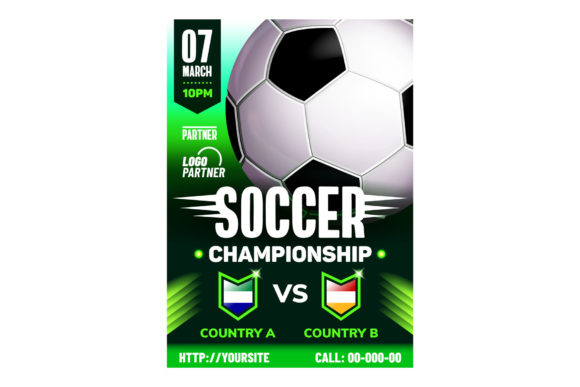
The phrase Soccer Sport Championship Final Game conjures a thrilling, singular moment of athletic excellence. For fans, it’s the pinnacle of competition. But for a broader audience—including marketers, designers, educators, and content creators—it represents a powerful creative concept and a suite of visual assets. The event itself and resources like a Soccer Sport Championship Final Game Poster Vector or a Soccer Gaming Ball On Advertising Promotion Banner are invaluable tools for communication and promotion. Understanding how to effectively leverage these concepts, however, requires navigating common pitfalls that can undermine your project’s impact.
Misunderstanding the Asset’s Core Purpose
A frequent oversight is treating all soccer championship visual resources as interchangeable. Many assume a vibrant Active Football Player Kicker Sportlife Style Colorful Concept Mockup Illustration serves the same function as a clean, scalable Soccer Sport Championship Final Game Poster Vector. This mistake directly affects the quality and professionalism of your final output.
For example, using a JPG mockup illustration as the base for a large-format print banner can result in a blurry, pixelated display because JPGs, while great for photos, lose quality when resized extensively. Conversely, using a minimalist EPS vector file for a dynamic, textured social media post might fail to capture the energetic feel you need. The format—JPG, EPS—is not just a technical detail; it dictates the asset’s usability. A vector EPS file is infinitely scalable without loss, ideal for logos, posters, and designs that require frequent size adjustments. A high-resolution JPG is perfect for realistic scenes, detailed mockups, and web-based graphics where photorealistic quality is key.
Practical advice: Before downloading or purchasing any asset, clearly define its end use. Is it for a scalable logo on a website (choose vector), or a background image for a one-time event brochure (high-res JPG may suffice)? Checking the file format description and intended use notes provided by the creator is a simple step that prevents wasted time and substandard results.
Overlooking Licensing and Customization Boundaries
Another common area of confusion revolves around licensing and the extent of permitted customization. Beginners and even seasoned professionals sometimes download a Soccer Gaming Ball On Advertising Promotion Banner mockup and aggressively modify it for a commercial product without verifying the license. This can lead to legal issues and damage to your brand’s reputation.
Realistically, most stock vectors and mockups come with specific licenses. Some allow full commercial use and modification, while others may restrict resale or require attribution. A mistake here isn’t merely about breaking rules; it’s about the risk of having to suddenly rebrand a campaign or face a dispute, costing both money and credibility.
A better approach: Always read the license terms before finalizing your choice. If you need a completely unique design, consider hiring a designer to create original artwork based on the concept, rather than relying on a stock asset with restrictive terms. For most promotional uses, selecting assets with clear, commercial-use licenses and noting any requirements is a safe and efficient path.
Neglecting Audience Context and Message Alignment
Selecting a Colorful Concept Mockup Illustration simply because it looks energetic, without aligning it with your specific message, is a frequent misstep. The Soccer Sport Championship Final Game theme evokes competition, victory, and teamwork, but the nuance matters. An illustration focused on a solitary player kicking might emphasize individual excellence, perfect for a personal training app ad. A poster vector showcasing a team celebration better conveys unity, suitable for a corporate team-building event promotion.
This oversight affects communication efficiency. Your graphic should amplify your text, not confuse it. Using an overly generic soccer ball banner for a serious, data-driven sports analytics conference would create a dissonance that weakens your presentation.
What to check: Analyze the core message of your project. Then, evaluate the visual assets not just for aesthetic appeal, but for thematic congruence. Does the asset’s focus (individual vs. team, abstract vs. realistic, modern vs. classic) match your brand voice and the message you are sending to your audience? This alignment turns a good graphic into an effective communication tool.
Poor Technical Execution in Application
Even with the perfect asset, mistakes in application can degrade the final product. Common errors include improper resolution settings, ignoring color profiles, and clumsy integration with other design elements. For instance, placing a crisp EPS vector onto a banner background without matching the color palette can make the design feel disjointed. Similarly, using a JPG mockup at too low a resolution for a high-density print job will reveal flaws in the final output, reducing satisfaction for both you and your clients or audience.
These technical choices impact usability and professional perception. A blurry poster or a banner with clashing colors fails to command attention and can even harm the perceived value of the event or product you’re promoting.
Practical correction: Learn the basic requirements of your output medium. For print, understand required DPI (dots per inch) and color modes (CMYK). For web, know optimal pixel dimensions and RGB color. Use professional design software (like Adobe Illustrator for vectors, Photoshop for JPGs) to properly integrate assets, ensuring layers are managed, colors are unified, and the final composite looks cohesive. If your skills are limited, consider collaborating with a graphic designer for the final assembly phase; it’s an investment that protects the quality of your core idea.
Failing to Plan for Versatility and Future Use
A shortsighted mistake is acquiring a visual asset for a single, immediate project without considering its potential for reuse. A well-chosen Soccer Sport Championship Final Game Poster Vector in EPS format, with editable colors and elements, can be adapted for future events, seasonal promotions, or different marketing channels. Many creators and small business owners buy a one-off JPG for a specific banner and then need a completely new asset for a related follow-up campaign, incurring extra cost and time.
This affects long-term efficiency and cost-effectiveness. Building a library of versatile, high-quality core assets is a smarter strategy than repeatedly sourcing disposable graphics.
Advice for a better choice: When evaluating assets, look for versatility. Does the vector file have separable elements? Does the mockup illustration come with layers that allow easy text or logo changes? Investing slightly more in a flexible, multi-purpose asset often provides greater value over time than buying several limited-use items. Think of your graphic assets as part of a sustainable brand toolkit, not as one-time consumables.
Ultimately, whether you are a blogger creating content about the championship spirit, a marketer promoting a related event, or an educator designing engaging materials, the concept of the Soccer Sport Championship Final Game and its associated visual resources offer tremendous utility. By avoiding these common pitfalls—misunderstanding formats, neglecting licenses, misaligning messages, executing poorly, and planning short-term—you elevate your work from simply using a graphic to strategically applying a powerful visual concept. The result is more professional, effective, and satisfying outcomes that truly capture the energy and excellence of the final game.