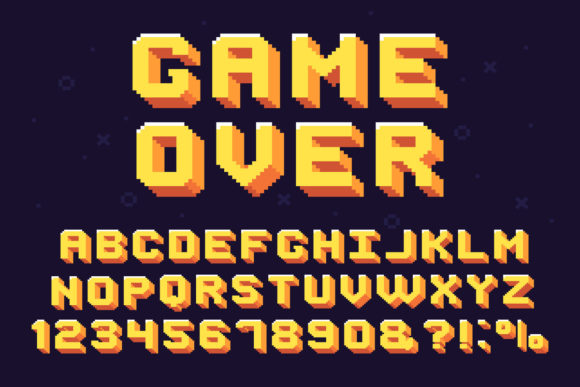
The Pixel Game Retro Games Text Typeface
You see it on websites, in marketing campaigns, on posters, and even in app interfaces: a bold, chunky typeface that instantly evokes the sound of coin drops and the glow of a CRT screen. This is Pixel Game Retro Games Text, a font that captures the essence of 90s gaming and 8-bit computer graphics. It’s more than just a nostalgic novelty; it’s a powerful visual tool with distinct characteristics and surprisingly broad applications.
At its core, this pixelated typeface is a digital homage. Each letter, number, and symbol is constructed from discrete blocks, mimicking the limited graphical capabilities of arcade machines and early home computers. The result is a font that feels inherently digital yet warmly vintage. Its key strength lies in its immediate communicative power. Using Pixel Game Retro Games Text doesn’t just convey words; it conveys an era, an emotion, and a specific aesthetic—one defined by creativity within constraints.
Decoding the 8-Bit Graphic Letter
What makes this font stand out from other retro-inspired designs? First, its authenticity. The letterforms aren't merely smoothed-out approximations; they genuinely appear as if rendered on a low-resolution grid. This gives it a notable quality of rawness and charm. Second, its versatility within its own style. A complete set, including a 90s gaming alphabet and a range of retro vector symbols, allows for the creation of coherent, immersive designs. You can build entire interfaces or logos that feel unified, not just drop in a single nostalgic word.
Another characteristic is its boldness. These letters are not delicate. They command attention, making them excellent for headlines, calls to action, or any element that needs to pop from the background. This isn’t a font for lengthy body text, but for strategic, impactful moments in your design.
Practical Applications Beyond the Arcade
The utility of Pixel Game Retro Games Text extends far beyond designing a game homage. Its practical applications are found across professional and creative fields. For marketers and entrepreneurs, it offers a direct path to a specific demographic. Using it in a campaign targeting adults who grew up in the 80s and 90s can trigger powerful nostalgic engagement, making your message more memorable.
Educators and publishers might use it to create engaging materials for topics related to technology history, digital art, or pop culture. Its visual style can make learning materials more approachable and visually stimulating. For bloggers and content creators, it provides a way to instantly establish a thematic tone—think of a tech blog’s logo or the title graphics for a YouTube series on retro computing.
Real-World Use Cases and Examples
Consider a local cafe hosting a retro gaming night. Their promotional poster, using Pixel Game Retro Games Text for the event title and key details, immediately communicates the theme more effectively than any generic font could. A software developer creating a minimalist pixel-art tool might use this font within the application’s UI itself, creating a seamless and authentic user experience from the interface to the output.
In digital spaces, this font can enhance branding consistency. An online store selling vintage gadgets or replica consoles could weave the pixelated typeface into its logo, product badges, and special offer banners. This creates a cohesive visual world that strengthens brand identity and builds trust with a niche audience. For freelancers and hobbyists, particularly in digital art or indie game development, having access to a high-quality, scalable vector set means they can produce professional-looking titles, logo mockups, and asset labels without needing to painstakingly draw each letter themselves.
Benefits in Usability and Communication
The benefits of integrating such a specialized font are multifaceted. From a usability standpoint, its high-contrast, blocky forms are often very legible at larger sizes, even on busy backgrounds. This can improve the user experience in key interaction points, like navigation labels or important buttons in a themed app.
In terms of communication and engagement, its primary benefit is speed. It bypasses lengthy explanation. A viewer understands the contextual message—retro, gaming, digital, fun, creative—in a fraction of a second. This efficiency is invaluable in crowded media environments. For productivity, it solves a specific problem: needing a ready-made, authentic asset. Instead of searching for disparate graphic elements or commissioning custom art, a creator can use a coherent Pixel Game Retro Games Text set to quickly assemble visually compelling work.
Selecting and Implementing Pixel Game Retro Games Text
When evaluating this or any similar asset, there are practical considerations to keep in mind. First, assess the completeness of the set. Does it include the full alphabet, numbers, and essential symbols? The product file mentioned, a high-resolution JPEG, is a great starting point, but the advice to use a vector editor like Adobe Illustrator for separation and editing is crucial. A JPEG is a static image; vector editing allows you to infinitely scale, recolor, and isolate individual letters without loss of quality, unlocking true flexibility.
Consider your delivery medium. For web use, you may need to convert edited vector letters into a web font format. For print, the high-resolution source ensures clarity. Also, think about stylistic pairing. Pixel Game Retro Games Text is dominant. It often works best when paired with a very clean, modern sans-serif font for body text, creating a balance between evocative nostalgia and readable information.
Finally, use it with intention. Its power is in its specificity. Overusing it can dilute its impact and make a design feel kitschy rather than curated. Deploy it for key headlines, logos, or thematic accents where its unique voice will be most effective. By understanding its characteristics, strengths, and realistic applications, you can leverage Pixel Game Retro Games Text not just as a font, but as a versatile tool for visual communication.