The Philosophy of Persistence: From "Game Over" to "Try Never Again"
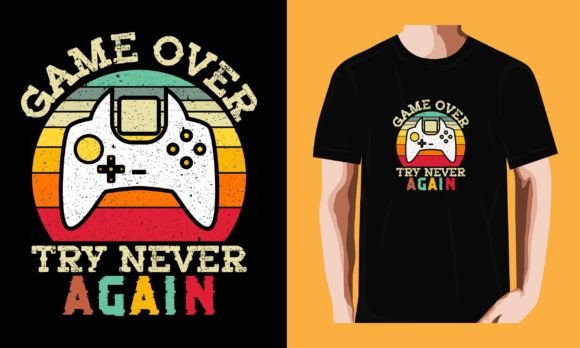
The phrase "Game Over" is a universal signifier, a moment of definitive conclusion recognized across cultures and generations. It marks the end of a session, a challenge met or failed. Yet, the compelling twist "Try Never Again" transforms this terminal point into a manifesto of relentless perseverance. This conceptual pairing, moving from a state of finality to an ethos of continual effort, resonates deeply, particularly within the gaming community. Its visual representation as a t-shirt design is not merely apparel; it is a statement piece that encapsulates a mindset.
A Design Born from Digital Culture
The aesthetic of "Game Over, Try Never Again" is inherently rooted in the pixelated screens and arcade cabinets of gaming history. The design evokes the stark, often red or white, "Game Over" screens of classic 80s and 90s video games. The addition of "Try Never Again" subverts that nostalgia, injecting a modern, almost defiant, persistence. This creates a powerful visual tension. For creators, having access to the design in versatile file formats—EPS for scalable vector editing, AI for Adobe Illustrator workflows, and PNG for ready-to-use raster images—is crucial. This flexibility transforms a potent phrase into a tangible asset.
The Practical Power of Multi-Format Files
Why does the specification of EPS, AI, and PNG files matter so much for a design like this? Each format serves a distinct purpose in the creator's toolkit, unlocking different applications.
- EPS (Encapsulated PostScript): This vector format is the foundation for professional-grade reproduction. It allows the design to be scaled infinitely without loss of quality, making it perfect for large format printing on bags or banners, as well as meticulous engraving on mugs or decals.
- AI (Adobe Illustrator Art File): For designers who wish to customize or integrate the design into larger projects, the native AI file provides complete access to layers, color paths, and typography. This enables altering colors for different clothing lines or extracting elements for card making backgrounds.
- PNG (Portable Network Graphics): With transparency support, a high-quality PNG is the ready-to-apply asset. It can be directly placed onto digital mockups of t-shirts, pillows, or used in web illustrations and social media content with minimal technical hassle.
This multi-format approach ensures the design is not a static image but a adaptable resource.
Real-World Applications Across Industries
The utility of such a design extends far beyond a simple cotton tee. Its message and aesthetic have cross-disciplinary appeal.
For Merchandise and Retail
At its core, the design is perfect for apparel. It speaks directly to gamers, but also to a broader audience who appreciates a message of resilience. On t-shirts, hoodies, and caps, it functions as wearable motivation. Its clean, often high-impact typography makes it equally suitable for sublimation printing on pillows or heat transfer onto bags. The phrase's edge works well for decals on laptops, cars, or gaming setups, personalizing spaces with a creed of determination.
For Creative and Professional Use
Graphic designers and illustrators can leverage the provided files in client work. The design might serve as a striking background element in a poster for a tech startup focused on innovation, or as an illustrative component in a presentation about overcoming project failures. In card making, elements from the vector file can be isolated and used to create unique, motivational greeting cards. The "Try Never Again" ethos is universally applicable, making the visual asset valuable for projects in education, coaching, or business branding where perseverance is a key theme.
The Message as a Cultural Touchstone
Beyond its applications, the phrase itself carries significant weight. "Game Over" acknowledges failure, setback, or the end of an attempt. It is honest and realistic. "Try Never Again" does not imply ignorance of that failure; instead, it advocates for a refusal to let that endpoint be permanent. It suggests an iterative process, a loop where every "Game Over" is merely a prompt to reset and re-engage. This philosophy aligns with modern concepts in software development (agile iteration), entrepreneurship (failing forward), and personal development (growth mindset).
The design, therefore, becomes a badge for those who embrace this iterative loop. It is for the developer debugging code, the entrepreneur pitching a venture after a previous rejection, the student studying for a retake exam, or the artist revising a draft. The gaming connotation makes it accessible and cool, while the underlying message provides substantive depth.
Characteristics of an Effective Message-Driven Design
Observations of successful text-based designs like this one highlight several key characteristics. The phrasing must be concise and memorable. The typography must visually reinforce the message—often bold, blocky fonts for "Game Over" with a contrasting, perhaps sleek or handwritten, style for "Try Never Again" to create dialogue. Color choice is critical: high-contrast combinations (black/white, red/white) ensure legibility and impact across all print mediums, from dark garment fabrics to ceramic mugs.
Furthermore, the design’s advantage lies in its ambiguity. It is not explicitly about video games; it uses gaming lexicon as a metaphor. This allows it to connect with niche audiences (gamers) while remaining broadly interpretable for general consumers, professionals, and hobbyists. A business owner might see it as a mantra for customer acquisition, while a researcher might relate it to experimental trials.
Considerations for Implementation and Use
For anyone utilizing these EPS, AI, and PNG files, certain practical considerations ensure optimal results. On clothing, especially t-shirts, placement is key. Center chest or left chest placements are standard for such statement text. For mugs, the design must be oriented correctly for the curved surface. When using the PNG as a background or illustration in digital media, ensuring the transparent background is preserved maintains professional quality.
It is also important to consider the context. The "Game Over, Try Never Again" design carries a specific, driven energy. It is best suited for projects, products, or audiences aligned with themes of challenge, competition, self-improvement, or tech culture. Using it in contexts requiring softness or solemnity might not resonate.
Ultimately, the provision of the design in these professional file formats democratizes creation. It allows a small hobbyist making decals at home, an educator preparing classroom materials, and a large clothing brand developing a new line to all start from the same high-quality asset. This scalability from individual craft to commercial production underscores the real-world relevance of versatile digital design resources.
The journey from seeing a "Game Over" screen to adopting a "Try Never Again" attitude is a narrative of modern resilience. Capturing that narrative in a visually stark, format-flexible design transforms a personal philosophy into a shared symbol, ready to be worn, used, and displayed across the myriad touchpoints of our daily lives and creative endeavors.